Riemann integration, compactness, and sets of measure zero.
In this exposition
The mechanism
Turn local oscillation into finite control
For the sufficiency direction of Lebesgue’s criterion, the proof groups points by the amount a bounded function can oscillate near them. Covering the exceptional set and using compactness elsewhere turns local information into a finite partition with a small Darboux gap.
What becomes elementary: A pointwise continuity condition becomes a quantitative estimate on upper and lower sums.
Follow the passage from oscillation to a finite cover and then to the partition estimate. Compare the same local-to-global operation in the product proof.
Explore further constructions. Edition dates, sources and reference chapters identify the scope of each study.
Overview
A bounded function whose discontinuities form a set of measure zero is Riemann integrable. We prove this by covering the discontinuities with intervals of small total length and using continuity on the complement to control oscillation. A finite subcover yields a partition for which every term in the Darboux gap is controlled by one of these two estimates. The construction keeps track of cell endpoints, where bounds on open intervals alone would not suffice. A final application uses the same division of the Darboux sum to prove stability under continuous composition.
1 · The theorem and its proof
Throughout, . When , the integral is zero; the proof below treats .
Theorem 1 (Lebesgue’s criterion, sufficiency). Let be bounded. If its set of discontinuities has Lebesgue measure zero, then is Riemann integrable on .
Proof.Step 1: Choose the two tolerances. Put . If , the result is immediate. Assume and fix . We will construct a partition such that .
Step 2: Cover the discontinuities. Since has measure zero, there are open intervals such that
Write and . The set is compact, and is continuous at each of its points, as a function on .
Step 3: Control oscillation on closed neighborhoods. For each , continuity gives such that
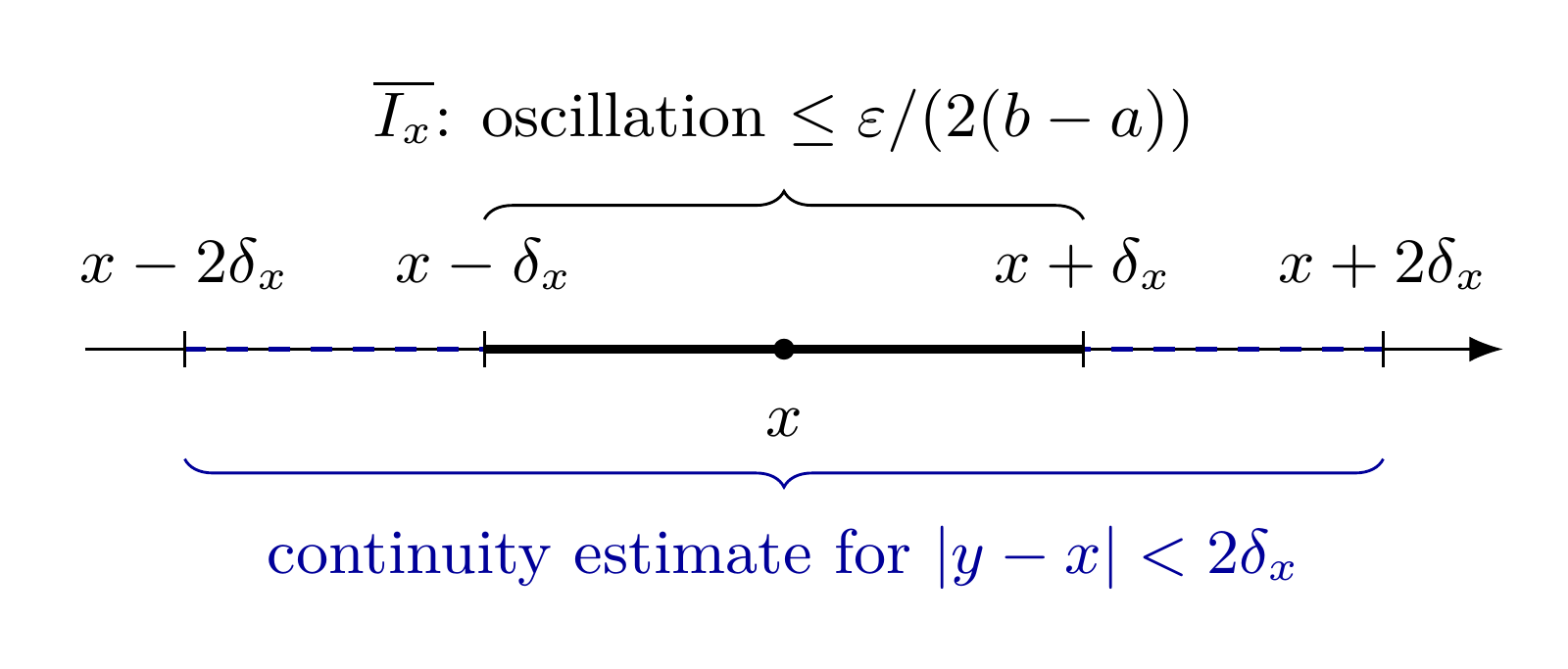
Set . If , their distances from are at most . Thus
Taking a supremum over pairs gives the non-strict bound
Here for a nonempty set . The factor of two in the choice of radius ensures that the estimate includes the endpoints of .
Figure 1. The closed interval lies inside the neighborhood where continuity controls the values of . All estimates are restricted to .
Step 4: Pass to a finite cover. The family covers . By compactness it has a finite subcover
Either part may be empty. Let consist of and every endpoint of an interval in that lies in . In increasing order these points form a partition
Step 5: Locate each open cell in the cover. Each cell is contained in at least one interval of . To see this, choose and an interval containing . No endpoint of lies inside the cell, so and . Hence .
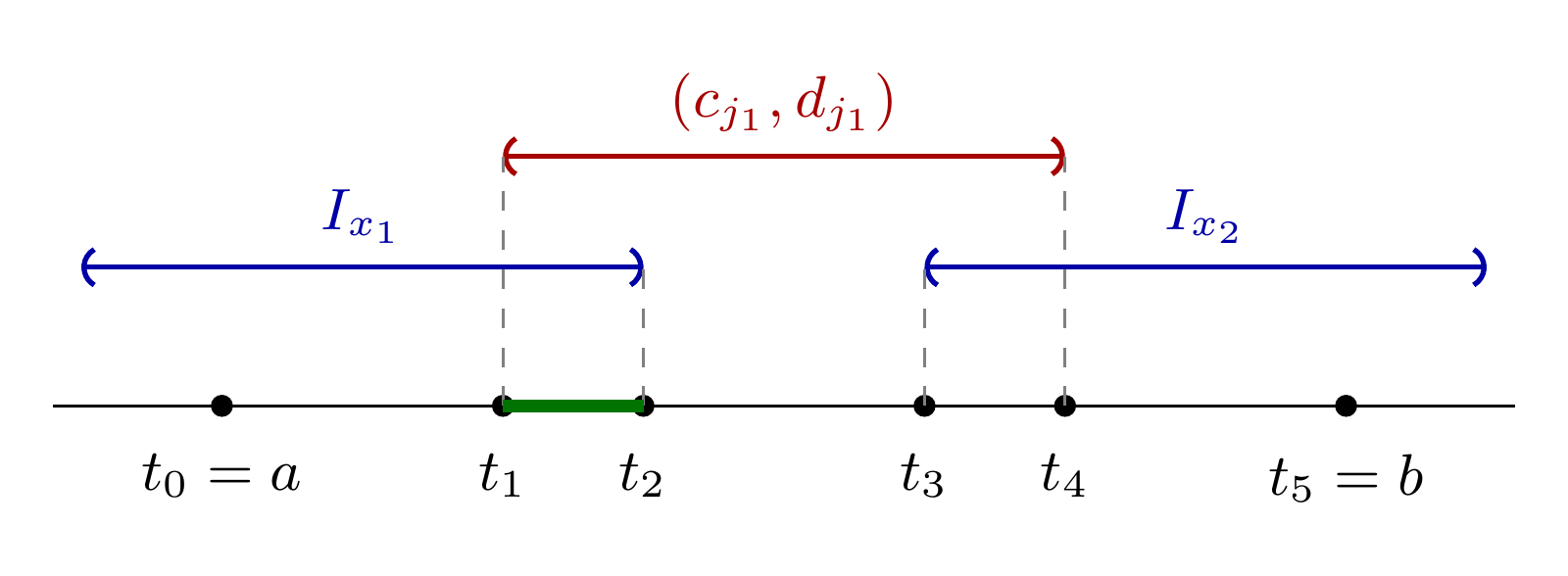
Figure 2. The cover endpoints determine the partition. Covering intervals may overlap: the highlighted cell lies in two of them. The open partition cells themselves are disjoint.
Step 6: Estimate the Darboux gap. Put and . Divide the indices into two disjoint classes:
: those for which for some ;
: all remaining indices, whose open cells must therefore lie in one of the selected intervals .
For , taking closures gives . By Step 3,
For , boundedness gives . The corresponding open cells are pairwise disjoint and lie in , so additivity of length on disjoint intervals and countable subadditivity give
Their endpoints need not lie in : the bound holds on every closed cell. Consequently,
Adding the two estimates yields
The Darboux criterion proves the theorem. ◻
2 · Two ways to control the same sum
Each term of the Darboux gap is a product of an oscillation and an interval length. The proof uses this in two complementary ways. On the cells indexed by , continuity controls the oscillation while their total length is at most . On those indexed by , boundedness controls the oscillation while the measure-zero hypothesis makes their total length small. Assigning each cell to exactly one class makes the estimates compatible even when the covering intervals overlap.
The argument depends on the total length of a cover, not on how densely the discontinuities are distributed. For example, Thomae’s function on is defined by for a rational in lowest terms with , and for irrational . For any fixed bound on , only finitely many such rationals lie in . This proves continuity at every irrational point; density of the irrationals proves discontinuity at every rational point. Its discontinuity set is therefore dense and countable, but has measure zero, so the theorem applies.
Uncountable discontinuity sets are also possible. The indicator of the middle-thirds Cantor set on is discontinuous exactly on that set: it is locally constant on the complement, while every neighborhood of a point in the set meets the complement. Since the Cantor set has measure zero, its indicator is Riemann integrable as well.
3 · Continuous composition
The same division of the Darboux sum proves the following closure property directly. This argument uses neither direction of Lebesgue’s criterion.
Corollary 2. If is Riemann integrable and is continuous, then is Riemann integrable on .
Proof. The case is immediate. Assume and put . Continuity on the compact interval gives a constant with . Given , uniform continuity gives such that
For a partition , put , , and . By the Darboux criterion for , choose with
On cells with , every pair of values of differs by less than . Hence , and these cells contribute at most to the Darboux gap for .
The remaining cells have , so their total length is at most . Since on every cell, they contribute strictly less than . Therefore
The composition is bounded by , so the Darboux criterion finishes the proof. ◻