A proposed countable partition into closed sets is tested by looking at what remains after its pieces are removed. Closedness in the real line is essential. The argument uses a nonempty closed remainder and Baire category to expose the contradiction.
What becomes elementary: The global partition question is concentrated into a topological obstruction on a carefully chosen remainder.
Keep ambient closedness distinct from relative closedness, and check nonemptiness before applying Baire category.
Explore further constructions. Edition dates, sources and reference chapters identify the scope of each study.
Theorem 1. There does not exist a sequence of pairwise disjoint closed subsets of such that
Step 1: Pass to the compact interval [0,1]
Proof. Assume, for contradiction, that such a sequence exists. Let
Then is a sequence of pairwise disjoint closed subsets of whose union is all of :
For each , let
denote the interior of relative to , and define
Thus is the part of left over after removing its relative interior. Now set
Since is open in , the set is closed in . As is compact, is compact and therefore a complete metric space.
The endpoint lies in no relative interior. Thus is nonempty. Because the sets are pairwise disjoint and cover , we have
and each is closed in .
Step 2: Apply the Baire category theorem
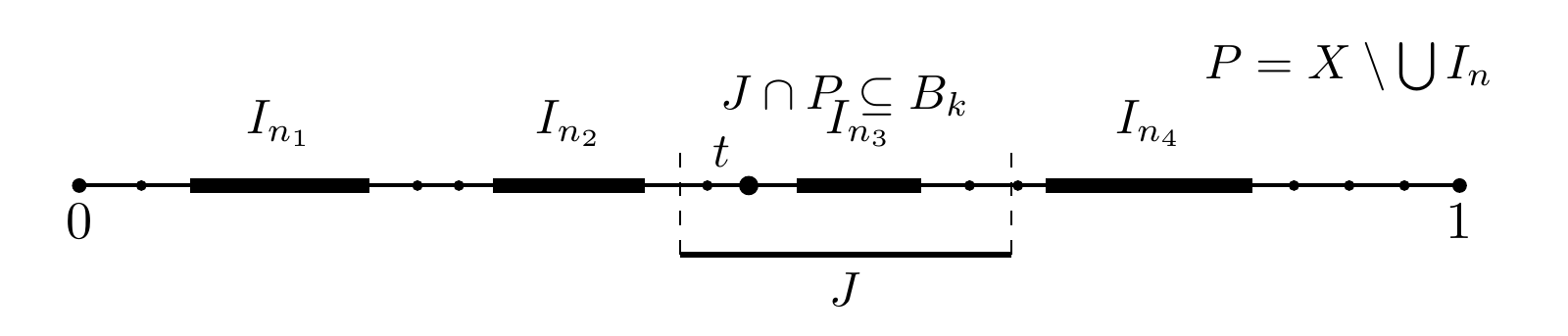
Since is a complete metric space and is expressed as a countable union of closed subsets, the Baire category theorem implies that at least one of the sets has nonempty interior relative to . Thus there exist an index and a nonempty set , open in , such that
Choose a point . Since is open in the subspace , there exists a nondegenerate interval , open in , such that
Then
Step 3: Use disjointness and connectedness
Fix any . Since
and , the inclusion implies that
Therefore every point of lies either in or in , so
The sets and are disjoint open subsets of . Since is connected, it follows that either
The second alternative is impossible, because while , so , hence . Thus
Since the sets partition , we conclude that
But is open in , so this implies
In particular, . On the other hand, , so . This is a contradiction. Hence no such decomposition of exists.
Figure 1. Schematic picture of the proof. The thick subintervals represent relative interiors , while the remaining closed set consists of the points not lying in any . Baire yields an interval such that lies entirely in a single boundary piece . Connectedness then forces all of into , contradicting the fact that .
 Refacte