# Extracting the First Prime Greater than \(m\)
## Abstract {#abstract}
For an integer \(m\geq 3\), define
\[
d=\gcd\bigl((m!)^{m!}-1,(2m)!\bigr),\qquad
t=\frac{d^d}{\gcd(d^d,d!)}.
\]
Let \(a\) be the largest nonnegative integer such that \(d^a\mid t\). We prove that
\[
\frac{d}{\gcd(t/d^a,d)}
\]
is the smallest prime greater than \(m\). The construction has two stages: first \(d\) isolates exactly the primes in the interval \((m,2m)\), and then the factorial \(d!\) distinguishes the smallest of those primes by giving it the largest valuation.
## Introduction {#introduction}
This problem was mentioned to me on IRC. The following argument explains why the construction works: one stage isolates a finite set of primes, and the other uses factorial valuations to distinguish its smallest member.
There are two separate filters in the formula. The first filter is
\[
d=\gcd\bigl((m!)^{m!}-1,(2m)!\bigr).
\]
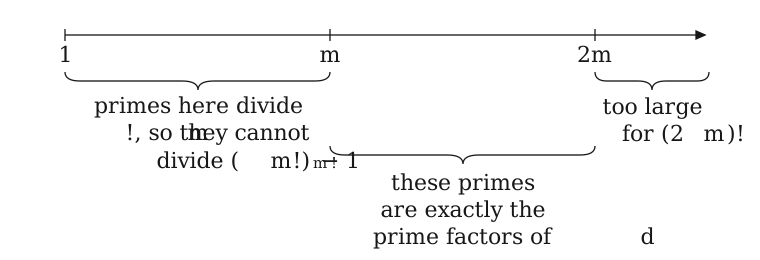
The factor \((2m)!\) prevents primes larger than \(2m\) from appearing, while the congruence condition modulo \((m!)^{m!}-1\) prevents primes at most \(m\) from appearing. What remains is precisely the set of primes strictly between \(m\) and \(2m\).
Figure 1: The first gcd filters primes according to their position relative to m.
The second filter is more subtle. Once \(d\) has been shown to be a squarefree product
\[
d=p_1p_2\cdots p_k,\qquad m1\), there is a prime \(p\) such that
\[
nm\). Since \(m\geq 3\), the endpoint \(2m\) is composite, so \(p\neq 2m\). Hence
\[
mm\), the prime \(p\) does not divide \(m!\). Hence Fermat’s little theorem gives
\[
(m!)^{p-1}\equiv 1\pmod p.
\]
It remains to know that the exponent \(m!\) is compatible with this congruence.
Except for the small case \((m,p)=(3,5)\), one has
\[
p-1\mid m!.
\]
Indeed, write
\[
p-1=2q,\qquad q=\frac{p-1}{2}.
\]
If \(p=5\), then \(m=3\) or \(m=4\). The case \(m=4\) gives \(4=p-1\mid4!\), while the case \(m=3\) is the exceptional case just mentioned. If \(p>5\), then \(q\geq 3\), and from \(p<2m\) we get \(qm\), we have \(2p>2m\), so \(p\) occurs exactly once in \((2m)!\). Consequently \(p\) occurs exactly once in \(d\).
We have shown that the prime divisors of \(d\) are exactly the primes in \(\mathcal P_m\), each with exponent \(1\). Hence
\[
d=\prod_{p\in\mathcal P_m}p.
\]
Finally, Bertrand’s postulate ensures that \(\mathcal P_m\) is nonempty, so \(d\neq1\). \(\square\)
Now list the primes in \(\mathcal P_m\) in increasing order:
\[
\mathcal P_m=\{p_1,p_2,\ldots,p_k\},\qquad p_1f_2>\cdots>f_k
\]
whenever \(k>1\). Consequently, if
\[
t=\frac{d^d}{\gcd(d^d,d!)},
\]
then the largest nonnegative integer \(a\) such that \(d^a\mid t\) is
\[
a=d-f_1.
\]
*Proof.* Since \(d=p_1p_2\cdots p_k\) is squarefree, the exponent of \(p_i\) in \(d^d\) is exactly \(d\). Also
\[
f_i=\nu_{p_i}(d!)=\left\lfloor\frac{d}{p_i}\right\rfloor+\left\lfloor\frac{d}{p_i^2}\right\rfloor+\left\lfloor\frac{d}{p_i^3}\right\rfloor+\cdots.
\]
Because \(p_i>m\geq3\), we have \(p_i\geq5\), and therefore
\[
f_i\leq\frac{d}{p_i}+\frac{d}{p_i^2}+\frac{d}{p_i^3}+\cdots=\frac{d}{p_i-1}\frac{d}{p_j}.
\]
Thus \(f_i>f_j\). In particular,
\[
f_1>f_2>\cdots>f_k
\]
when \(k>1\).
Let
\[
e_i=d-f_i.
\]
Then
\[
t=\prod_{i=1}^k p_i^{e_i},
\]
and the inequalities among the \(f_i\) reverse to give
\[
e_11\). Since \(d\) is squarefree, \(d^a\mid t\) exactly when every exponent \(e_i\) is at least \(a\). Therefore the largest possible \(a\) is
\[
a=\min_i e_i=e_1=d-f_1.
\]
The same formula is also valid when \(k=1\), where the minimum consists of the single exponent \(e_1\). \(\square\)
We can now finish the proof of the theorem. By the preceding lemma,
\[
a=d-f_1.
\]
Therefore
\[
\frac{t}{d^a}=\frac{\prod_{i=1}^k p_i^{d-f_i}}{\prod_{i=1}^k p_i^{d-f_1}}=\prod_{i=1}^k p_i^{f_1-f_i}.
\]
The exponent of \(p_1\) in this product is \(0\), while for every \(i>1\), the exponent of \(p_i\) is positive. Hence
\[
\gcd\left(\frac{t}{d^a},d\right)=p_2p_3\cdots p_k,
\]
where the empty product is interpreted as \(1\) when \(k=1\). It follows that
\[
\frac{d}{\gcd\left(\dfrac{t}{d^a},d\right)}=\frac{p_1p_2\cdots p_k}{p_2p_3\cdots p_k}=p_1.
\]
By construction, \(p_1\) is the smallest prime in the interval \((m,2m)\). Bertrand’s postulate ensures that the least prime greater than \(m\) lies in this interval. Therefore \(p_1\) is the smallest prime greater than \(m\), as claimed.
## Appendix: Bertrand’s Postulate {#appendix-bertrand}
For completeness, we include a standard elementary proof of the form of Bertrand’s postulate used above.
### Lemma 3 {#lemma-3}
For every real number \(x\geq1\),
\[
\prod_{p\leq x}p<4^x,
\]
where the product is over primes \(p\leq x\).
*Proof.* It suffices to prove the claim for positive integers \(x=N\), since replacing \(x\) by \(\lfloor x\rfloor\) can only decrease the left-hand side.
We prove the integer case by strong induction on \(N\). The cases \(N=1,2\) are immediate. Suppose the result is known for all positive integers smaller than \(N\).
First let \(N=2r\). The product of the primes \(p\) with \(r1\), there is a prime \(p\) such that
\[
n1\) for \(n\geq468\). Since the central binomial coefficient is the largest coefficient in the expansion of \((1+1)^{2n}\), we have
\[
B_n\geq\frac{4^n}{2n+1}.
\]
Now factor \(B_n\) into primes. For a prime \(q\), write \(b_q=\nu_q(B_n)\). If \(q\leq\sqrt{2n}\), then each summand in
\[
b_q=\sum_{r\geq1}\left(\left\lfloor\frac{2n}{q^r}\right\rfloor-2\left\lfloor\frac{n}{q^r}\right\rfloor\right)
\]
is at most \(1\), so \(q^{b_q}\leq2n\). The total contribution from primes \(q\leq\sqrt{2n}\) is therefore at most \((2n)^{\sqrt{2n}}\).
If \(\sqrt{2n}\frac{4^{n/3}}{(2n+1)(2n)^{\sqrt{2n}}}.
\]
For \(x\geq468\), set
\[
\phi(x)=\frac{x}{3}\log4-\log(2x+1)-\sqrt{2x}\log(2x).
\]
Then
\[
\phi'(x)=\frac{\log4}{3}-\frac{2}{2x+1}-\frac{\log(2x)+2}{\sqrt{2x}}.
\]
The last two terms decrease in magnitude as \(x\) increases, and a direct calculation gives
\[
\phi'(468)>0.17,\qquad\phi(468)>0.1.
\]
Thus \(\phi(x)>0\) for all \(x\geq468\). Equivalently,
\[
\frac{4^{n/3}}{(2n+1)(2n)^{\sqrt{2n}}}>1
\]
for every integer \(n\geq468\). Hence \(P_n>1\), so there is a prime \(p\) with \(n1\), this prime satisfies \(n1\). \(\square\)